
A really clear overview of how 3D scanning works Nathan!
I like that you include that the strengthen of the emerging technology as its overall weakness. The Ford & Minshal point regarding experimentation and failure as a key part of learning is very interesting and links back to creativity and learning being exacerbated by challenge.
A very clear write up! thanks Nathan!
Design based learning:
Hey Josh,
Your explanation of how the design process can be used within tinkercad shows a deep understanding of how the design process works in relation to education. Your explicit links between constructivism and the design process are well explained and understandable. I like how you’ve found an empirical study to support your claims of effectiveness. However an example of how tinkercad could be used in a specific lesson could give inspiration on how design based learning could be incorporated further into classrooms. All in all a great write up!
– Adam
Computational thinking
Hey Georgia,
You’re clear and concise as to what exactly blue-bots can do and the advantages of them in the classroom. I like how you mention they can be used easily by students of differing competency with technology. My only question is there any circumstance where they can be used cross-curricular?
Awesome write up!
Adam
Robotics:
Hey Genevieve,
The simple explanation of the strengths of Ozobots, as well as how they work, really makes me feel as if i could use them in future lessons. Considering the cost, what ratios of Ozobots to students do you think could be effective in activities like the ones you’ve described?
The pedagogical implications of Ozobot’s simplicity sounds great for earlier stages, however does this limit their use in higher stage classes where coding could become a focus?
Just food for thought, love your explanation!
Hey Ann,
i really like how you phrase the benefits of augmented reality as extending our natural abilities. It seems as if through the trace function of OSMO it emphasises how the element of shape can be utilised. Therefore modelling it for the student and potentially allowing them to use it without the scaffolding of the app. By effectively giving them a bank of stimulus shapes that form objects/animals/people, the benefits of creative pedagogy could be activated as well in almost any activity.
Do you think that the continued use of programs such as this could have any drawbacks for the student however as they come to rely on it too much?
Thanks Ann!
– Adam
I like how you’ve given a realistic example of VR’s ability to visualise scale (anatomy example). The ability to cover basic anatomy while exploring scale highlights the cross curricular applications of this technology and you’ve even provided academic evidence to prove its efficacy.
Awesome blog post,
– Adam
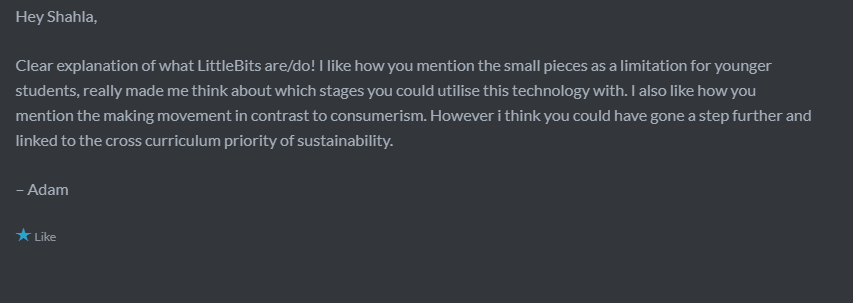
Constructionism and the Meaning Maker Movement: https://shahlaeduc362kaabi.wordpress.com/2019/05/25/week-12-constructionism-and-the-maker-movement/comment-page-1/?unapproved=42&moderation-hash=2bc428c2eec4d57b7a232e19ddeeb21b#comment-42
 Technology in Education
You must be logged in to post a comment.