
What is Design Based Learning (DBL)?
DBL is an inquiry based pedagogy allowing students to utilise real world design processes (Koldner, Scrismond, Fasse, Holbrook & Ryan, 2003). Students must engage and develop a deeper understanding of syllabus content through the higher order tasks of ‘apply, analyse, evaluate and create’ from Anderson’s, Krathwohl’s, Airasian’s, Cruikshank’s, Mayer’s, Pintrich’s, & Wittrock’s (2001) revised taxonomy of learning.
DBL uses and develops crucial 21st century skills such as creativity, critical thinking, problem solving, communication, collaboration and reflection (Scheltenaar, Poel & Bekker, 2015). These skills are crucial to children’s decision making development, as well as social development. Design process exact methodology varies, however there are general established steps. These include: inquiry or identification of the problem, investigation, exploring the possible options hypothetically, experimenting then evolving through reflection and revision. One such process is the IDEO design process:

Strengths of DBL:
The pedagogical strengths of DBL are many, however the key aspect is its ability to combine education and play (Scheltenaar et al, 2015). Play is crucial to children’s development in terms of engaging with content in new, experimental ways whilst also encouraging social and emotional development (Vygotsky, 1978; Bodrova, Germeroth & Leong, 2013). Utilising play within the classroom therefore creates an explorative, creative learning environment.
DBL traditionally has roots in education for science and engineering
(Koldner, Scrismond, Fasse, Holbrook & Ryan, 2003). However, the creative skills involved can be transferred across the curriculum to deepen understanding in all subjects (Razzouk, & Shute, 2012).
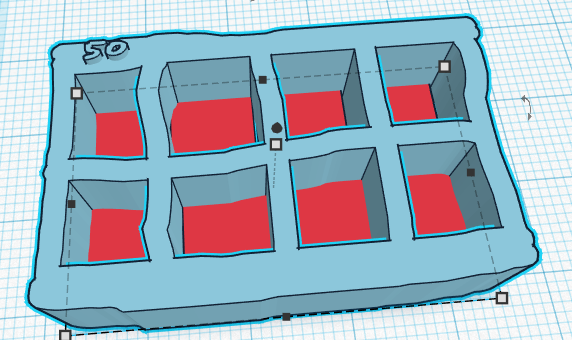
3D printing software such as Tinkercad can be used to implement DBL. Students in a mathematics ‘shop keeper’ scenario working on their money outcomes could, as a precursor activity, design a ’till’. This forces students to think about how they would manage/identify/count their money. One bowl? separating denominations? Covers to deter theft? Tinkercad allows students to devise their own design using their collaborative creative thoughts, in this case; managing money effectively. Real tills could be used as a model (professional modelling) as well as posing questions such as ‘What could make counting easier?’. 3D printing in this application creates an authentic context for the activity while allowing students to explore their ingenuity.
Limitations of DBL:
Teachers must take a range of variables into consideration when planning a DBL lesson. These in summary include: authentic experiences, task relevancy to syllabus content, encouraging communication/collaboration and modelling professional practice (Royalty, 2018). When these variables are accounted for, student creativity within DBL be utilised for educative purpose.
References:
Anderson, L. W., Krathwohl, D. R., Airasian, P. W., Cruikshank, K. A., Mayer, R. E., Pintrich, P. R., … & Wittrock, M. C. (2001). A taxonomy for learning, teaching, and assessing: A revision of Bloom’s taxonomy of educational objectives, abridged edition. White Plains, NY: Longman.
Bodrova, E., Germeroth, C., & Leong, D. J. (2013). Play and self-regulation: lessons from Vygotsky. American Journal of Play, 6(1), 111-123.
IDEO (2011). Design Thinking For Educators, 2nd edition. Retrieved from https://designthinkingforeducators.com/
Kolodner, J. L., Camp, P. J., Crismond, D., Fasse, B., Gray, J., Holbrook, J., … & Ryan, M. (2003). Problem-based learning meets case-based reasoning in the middle-school science classroom: Putting learning by design ™ into practice. The journal of the learning sciences, 12(4), 495-547.
Razzouk, R., & Shute, V. (2012). What is design thinking and why is it important?. Review of Educational Research, 82(3), 330-348.
Royalty, A. (2018). Design-based Pedagogy: Investigating an emerging approach to teaching design to non-designers. Mechanism and Machine Theory,125, 137-145.
Scheltenaar, K., Poel, J., & Bekker, M. (2015). Design-Based Learning in Classrooms Using Playful Digital Toolkits. Lecture Notes in Computer Science,LNCS-9353, 126-139.
Vygotsky, L. (1978). Interaction between learning and development. Readings on the development of children, 23(3), 34-41.

 Technology in Education
You must be logged in to post a comment.